Present Perfect Tense


Present Perfect Tense – Explanation

The Present Perfect Tense is used to talk about an action that started and finished in the past, but its result or effect is still relevant in the present, it means the action is over, but the result is not over.

Present Perfect Tense का प्रयोग ऐसे कार्य के लिए किया जाता है जो भूतकाल में पूरा हो चुका हो, लेकिन उसका प्रभाव या परिणाम अभी भी वर्तमान में बना हुआ हो

How the action is finished

  1. I have finished my homework.
    The homework is finished (past action complete).
    Effect now: I am free / I can relax.

  2. She has lost her keys.
    Losing happened earlier.
    Effect now: She cannot open the door.

  3. They have built a new house.
    The house construction is complete.
    Effect now: They are living in it.

  4. He has broken his leg.
    The leg was broken in the past.
    Effect now: He is still in pain / cannot walk properly.

  5. We have watched this movie.
    Watching is finished.
    Effect now: We don’t want to watch it again.

हिंदी में इसे समझने के लिए ये रूप उपयोग होते हैं:

  1. चूका है (Male singular)

  2. चुकी है (Female singular)

  3. चुके हैं (Plural or Respect)

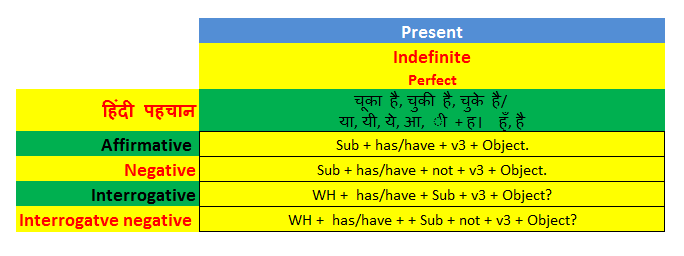
और क्रिया के अंत में या, यी, ये, आ, ई + है / हूँ / हैं आते हैं then it is present perfect tense.

1. Affirmative (सकारात्मक वाक्य)

  1. मैं खाना खा चूका हूँ

  2. वह किताब पढ़ चुकी है

  3. वे स्कूल जा चुके हैं

  4. अमित अपना काम पूरा कर चूका है

  5. हम फिल्म देख चुके हैं

2. Negative (नकारात्मक वाक्य)

  1. वह अभी तक नहीं आ चुकी है

  2. वे अपना काम पूरा नहीं कर चुके हैं

  3. अमित घर नहीं जा चूका है

  4. हम ये किताब नहीं पढ़ चुके हैं

3. Interrogative (प्रश्नवाचक वाक्य)

  1. क्या मैं खाना खा चूका हूँ?

  2. क्या वह काम कर चुकी है?

  3. क्या वे लौट चुके हैं?

  4. क्या अमित फोन कर चूका है?

  5. क्या हम वहाँ जा चुके हैं?

4. Negative-Interrogative (नकारात्मक प्रश्नवाचक वाक्य)

  1. क्या मैं खाना नहीं खा चूका हूँ?

  2. क्या वह अभी तक नहीं आ चुकी है?

  3. क्या वे काम पूरा नहीं कर चुके हैं?

  4. क्या अमित तैयार नहीं हो चूका है?

  5. क्या हम वहाँ नहीं जा चुके हैं?

Present Perfect Tense (Hindi Pattern: या, यी, ये, आ, ई+ है / हूँ / हैं) 

1. Present Perfect Tense - Affirmative Sentences

Structure: Subject + ने + Verb (या/यी/ये/आ/ई) + है/हूँ/हैं

  1. मैंने खाना खा लिया है

  2. उसने किताब पढ़ ली है

  3. उन्होंने अपना काम पूरा कर लिया है

  4. रीता ने चाय बना ली है

2. Present Perfect Tense - Negative Sentences 

Structure: Subject + ने + Verb (या/यी/ये/आ/ई) + नहीं + है/हूँ/हैं

  1. मैंने खाना नहीं खा या है

  2. रीता ने चाय नहीं बना ई है

  3. मैंने खाना नहीं खाया है

  4. उसने काम नहीं किया है

3. Present Perfect Tense - Interrogative Sentences 

Structure: क्या + Subject + ने + Verb + है/हूँ/हैं ?

  1. क्या रीता ने चाय बना ई है?

  2. क्या आपने खाना खा लिया है?

  3. क्या उसने काम पूरा किया है?

  4. क्या वे घर आ गए हैं?

4. Present Perfect Tense -Negative Interrogative Sentences  नकारात्मक प्रश्नवाचक वाक्य

Structure: क्या + Subject + ने + Verb + नहीं + है/हूँ/हैं ?

  1. क्या मैंने खाना नहीं खा या है?

  2. क्या रीता ने चाय नहीं बनाई है?

  3. क्या आपने अभी तक खाना नहीं खाया है?

  4. क्या उसने काम नहीं किया है?

Present Perfect Tense – Helping Verbs & Verb Forms

Only two helping verbs:

1) HAS (He, She, It, and Singular noun (boy, girl, teacher, Amit, dog, car, etc.))

2) HAVE (I, we, You, They, and Plural noun (students, people, boys, teachers, etc.))

Which Form of Main Verb?

Always use V3 (Past Participle)

1. Affirmative (सकारात्मक वाक्य)

Subject + has / have + V³ + Object

Examples:
I have finished my work.
मैंने अपना काम पूरा कर लिया है।

She has cooked food.
उसने खाना बना लिया है।

They have reached home.
वे घर पहुँच चुके हैं।

2. Negative (नकारात्मक वाक्य)

Subject + has / have + not + V³ + Object

Examples:
I have not seen this movie.
मैंने यह फिल्म नहीं देखी है।

He has not completed the task.
उसने काम पूरा नहीं किया है।

We have not received the message.
हमें संदेश नहीं मिला है।

3. Interrogative (प्रश्नवाचक वाक्य)

Has / Have + Subject + V³ + Object?

Examples:
Have you done your homework?
क्या तुमने अपना गृहकार्य कर लिया है?

Has she called you?
क्या उसने तुम्हें फोन किया है?

Have they left the office?
क्या वे दफ्तर से जा चुके हैं?

4. Negative Interrogative (नकारात्मक प्रश्नवाचक)

Wh + Has / Have + Subject + not + V³ + Object ?
or
Wh + Haven’t / Hasn’t + Subject + V³ + Object ?

Examples:
Have you not understood the lesson?
क्या तुमने पाठ नहीं समझा है?

Hasn’t he informed you?
क्या उसने तुम्हें जानकारी नहीं दी है?

Haven’t they finished the work?
क्या उन्होंने काम पूरा नहीं किया है?

Interrogative WH-Questions (Present Perfect)

WH-word + have/has + subject + V3 + etc.?

Examples:

  1. What have you eaten today?
    तुमने आज क्या खाया है?

  2. Where has she gone?
    वह कहाँ गई है?

  3. Who has called me?
    किसने मुझे कॉल किया है?

  4. Why have they left the party?
    उन्होंने पार्टी क्यों छोड़ी है?

  5. How long have you studied English?
    तुमने कितने समय से अंग्रेज़ी पढ़ी है?

Negative Interrogative WH-Questions (Present Perfect)

WH-word + haven’t/hasn’t + subject + V3 + ?

Examples:

  1. Why haven’t you finished your homework?
    तुमने अपना होमवर्क क्यों नहीं किया है?

  2. What hasn’t he told us yet?
    उसने हमें अभी तक क्या नहीं बताया है?

  3. Who hasn’t come to the meeting?
    कौन बैठक में नहीं आया है?

  4. Where haven’t they visited yet?
    वे अभी तक कहाँ नहीं गए हैं?

  5. How long hasn’t she spoken to you?
    उसने तुमसे कितने समय से बात नहीं की है?

Hindi To English Translation (How to Translate): 

  1. वह अपना काम पूरा कर चुका है।
    He has completed his work.
    यह affirmative sentence है। यहाँ subject he है, जो third person singular है, इसलिए helping verb has का प्रयोग किया गया है। Present perfect tense में verb की V3 form (completed) लगती है क्योंकि काम पूरा हो चुका है और उसका प्रभाव वर्तमान में है।

  2. मैं यह किताब पहले ही पढ़ चुका हूँ।
    I have already read this book.
    यह affirmative sentence है। यहाँ subject I है, इसलिए helping verb have का प्रयोग किया गया है। Present perfect tense में verb की V3 form (read) आती है, जिससे पता चलता है कि काम पूरा हो चुका है।

  3. वे दिल्ली पहुँच चुके हैं।
    They have reached Delhi.
    यह affirmative sentence है। यहाँ subject they plural है, इसलिए have का प्रयोग किया गया है। Verb की V3 form (reached) से पूर्ण हुआ कार्य व्यक्त होता है।

  4. उसने अभी तक खाना नहीं खाया है।
    He has not eaten food yet.
    यह negative sentence है। यहाँ subject he है, इसलिए has not का प्रयोग हुआ है। Present perfect tense में negative बनाने के लिए not और verb की V3 form (eaten) लगती है।

  5. मैंने अपना मोबाइल नहीं खोया है।
    I have not lost my mobile.
    यह negative sentence है। यहाँ subject I है, इसलिए have not का प्रयोग किया गया है। Verb की V3 form (lost) यह बताती है कि काम नहीं हुआ है।

  6. उन्होंने सच नहीं बताया है।
    They have not told the truth.
    यह negative sentence है। यहाँ subject they plural है, इसलिए have not लगाया गया है। Present perfect tense में verb की V3 form (told) प्रयोग होती है।

  7. क्या उसने अपना होमवर्क पूरा कर लिया है?
    Has he completed his homework?
    यह interrogative sentence है। यहाँ subject he है, इसलिए has को subject से पहले रखा गया है। Verb की V3 form (completed) present perfect tense में रहती है।

  8. क्या तुमने यह फिल्म देखी है?
    Have you watched this movie?
    यह interrogative sentence है। यहाँ subject you है, इसलिए have का प्रयोग हुआ है और helping verb को sentence के शुरू में रखा गया है। Verb की V3 form (watched) आती है।

  9. क्या उन्होंने हमें बुलाया है?
    Have they invited us?
    यह interrogative sentence है। यहाँ subject they plural है, इसलिए have का प्रयोग किया गया है। Verb की V3 form (invited) लगी है।

  10. क्या उसने अभी तक जवाब नहीं दिया है?
    Has he not replied yet?
    यह negative interrogative sentence है। यहाँ subject he है, इसलिए has पहले, फिर not, और verb की V3 form (replied) का प्रयोग किया गया है।

  11. क्या तुमने यह काम नहीं किया है?
    Have you not done this work?
    यह negative interrogative sentence है। यहाँ subject you है, इसलिए have का प्रयोग किया गया है। Present perfect tense में verb की V3 form (done) आती है।

  12. क्या हमने परीक्षा पास नहीं की है?
    Have we not passed the examination?
    यह negative interrogative sentence है। यहाँ subject we plural है, इसलिए have का प्रयोग हुआ है। Verb की V3 form (passed) कार्य की पूर्णता दर्शाती है।

  13. राम ने अपनी गलती मान ली है।
    Ram has accepted his mistake.
    यह affirmative sentence है। यहाँ subject Ram singular noun है, इसलिए has का प्रयोग किया गया है। Verb की V3 form (accepted) present perfect tense में आती है।

  14. बच्चों ने शोर मचाया है।
    The children have made noise.
    यह affirmative sentence है। यहाँ subject children plural है, इसलिए have का प्रयोग किया गया है। Verb की V3 form (made) का उपयोग हुआ है।

  15. उसने मुझे पहले ही बता दिया है।
    He has already informed me.
    यह affirmative sentence है। यहाँ subject he है, इसलिए helping verb has का प्रयोग किया गया है। Verb की V3 form (informed) काम के पूरा होने को दिखाती है।

  16. हमने यह नियम नहीं तोड़ा है।
    We have not broken this rule.
    यह negative sentence है। यहाँ subject we है, इसलिए have not का प्रयोग हुआ है। Present perfect tense में verb की V3 form (broken) आती है।

  17. क्या सीता ने यह पत्र लिखा है?
    Has Sita written this letter?
    यह interrogative sentence है। यहाँ subject Sita singular है, इसलिए has का प्रयोग किया गया है। Verb की V3 form (written) लगी है।

  18. क्या लोगों ने तुम्हारी बात समझी है?
    Have the people understood your point?
    यह interrogative sentence है। यहाँ subject people plural माना जाता है, इसलिए have का प्रयोग हुआ है। Verb की V3 form (understood) प्रयोग की गई है।

  19. क्या उसने कभी झूठ नहीं बोला है?
    Has he never told a lie?
    यह negative interrogative sentence है। यहाँ subject he है, इसलिए has का प्रयोग किया गया है। Verb की V3 form (told) present perfect tense में आती है।

  20. क्या तुमने अभी तक तैयारी पूरी नहीं की है?
    Have you not completed the preparation yet?
    यह negative interrogative sentence है। यहाँ subject you है, इसलिए have का प्रयोग हुआ है। Verb की V3 form (completed) यह बताती है कि काम अभी पूरा नहीं हुआ है।

Common Adverb of Time:

already (पहले ही)
Affirmative sentences में प्रयोग होता है।
I have already finished my work.
She has already left the office.

just (अभी-अभी)
काम के अभी हाल में पूरा होने को दिखाता है।
He has just arrived.
We have just completed the task.

yet (अब तक / अभी तक)
Negative और interrogative sentences में प्रयोग होता है।
I have not done my homework yet.
Have you finished the report yet?

ever (कभी)
प्रश्नवाचक वाक्यों में जीवन के अनुभव पूछने के लिए।
Have you ever visited Delhi?
Has she ever spoken to a foreigner?

never (कभी नहीं)
Negative अर्थ देता है, इसलिए “not” की ज़रूरत नहीं होती।
I have never seen such a place.
He has never told a lie.

recently (हाल ही में)
हाल की किसी घटना को बताने के लिए।
She has recently changed her job.
I have recently learned English grammar.

lately (हाल के दिनों में)
recently जैसा ही प्रयोग, पर थोड़े लंबे समय के लिए।
He has been very busy lately.
I have not watched TV lately.

so far (अब तक)
अब तक की स्थिति बताने के लिए।
We have completed five chapters so far.
She has not made any mistake so far.

till now / until now (अब तक)
अब तक की बात करने के लिए।
I have not received the message till now.
He has worked hard until now.

before (पहले)
पहले कभी होने या न होने की बात।
I have seen this movie before.
She has not met him before.

up to now (अब तक)
so far जैसा ही प्रयोग।
Up to now, I have understood the lesson.

1. Present Perfect Tense - Affirmative Sentences 

(Subject + has/have + V3)

  1. मैंने अपना काम पूरा कर लिया है।
    I have finished my work.

  2. उसने फिल्म देख ली है।
    She has watched the movie.

  3. उन्होंने यह किताब पढ़ ली है।
    They have read this book.

  4. हमने खाना खा लिया है।
    We have eaten the food.

  5. बच्चे स्कूल जा चुके हैं।
    The children have gone to school.

  6. रीना पानी पी चुकी है।
    Reena has drunk the water.

  7. मैंने तुमसे पहले ही बात कर ली है।
    I have already talked to you.

  8. शिक्षक ने नया अध्याय शुरू कर दिया है।
    The teacher has started the new chapter.

  9. डॉक्टर रोगी को देख चुका है।
    The doctor has examined the patient.

  10. मौसम ठंडा हो गया है।
    The weather has become cold.

2. Present Perfect Tense - Negative Sentences 

(Subject + has/have not + V3)

  1. मैंने अपना काम अभी तक पूरा नहीं किया है।
    I have not finished my work yet.

  2. उसने खाना नहीं खाया है।
    She has not eaten the food.

  3. हमने फिल्म नहीं देखी है।
    We have not watched the movie.

  4. उन्होंने चिट्ठी नहीं लिखी है।
    They have not written the letter.

  5. रीना ने पानी नहीं पिया है।
    Reena has not drunk the water.

  6. बच्चों ने होमवर्क नहीं किया है।
    The children have not done their homework.

  7. मैंने उससे बात नहीं की है।
    I have not talked to him/her.

  8. शिक्षक ने नया अध्याय शुरू नहीं किया है।
    The teacher has not started the new chapter.

  9. डॉक्टर ने मरीज को नहीं देखा है।
    The doctor has not seen the patient.

  10. मौसम अभी तक साफ नहीं हुआ है।
    The weather has not cleared yet.

3. Present Perfect Tense - Interrogative Sentences 

(Has/Have + subject + V3?)

  1. क्या आपने अपना काम पूरा कर लिया है?
    Have you finished your work?

  2. क्या उसने खाना खा लिया है?
    Has she eaten the food?

  3. क्या उन्होंने फिल्म देखी है?
    Have they watched the movie?

  4. क्या तुमने चिट्ठी लिखी है?
    Have you written the letter?

  5. क्या हमने यह किताब पढ़ ली है?
    Have we read this book?

  6. क्या बच्चों ने होमवर्क किया है?
    Have the children done their homework?

  7. क्या रीना पानी पी चुकी है?
    Has Reena drunk the water?

  8. क्या शिक्षक ने अध्याय शुरू किया है?
    Has the teacher started the chapter?

  9. क्या डॉक्टर ने मरीज को देखा है?
    Has the doctor seen the patient?

  10. क्या मौसम ठंडा हो गया है?
    Has the weather become cold?

4. Present Perfect Tense - Negative-Interrogative Sentences 

(Has/Have + subject + not + V3?)

  1. क्या आपने अभी तक काम पूरा नहीं किया है?
    Have you not finished your work yet?

  2. क्या उसने खाना नहीं खाया है?
    Has she not eaten the food?

  3. क्या उन्होंने फिल्म नहीं देखी है?
    Have they not watched the movie?

  4. क्या तुमने चिट्ठी नहीं लिखी है?
    Have you not written the letter?

  5. क्या हमने यह किताब नहीं पढ़ी है?
    Have we not read this book?

  6. क्या बच्चों ने होमवर्क नहीं किया है?
    Have the children not done their homework?

  7. क्या रीना ने पानी नहीं पिया है?
    Has Reena not drunk the water?

  8. क्या शिक्षक ने नया अध्याय शुरू नहीं किया है?
    Has the teacher not started the new chapter?

  9. क्या डॉक्टर ने मरीज को नहीं देखा है?
    Has the doctor not seen the patient?

  10. क्या मौसम अभी तक साफ नहीं हुआ है?
    Has the weather not cleared yet?

1. Action completed recently (often with just/already/yet)

English Examples

  1. I have just finished my homework.

  2. She has already eaten dinner.

  3. They have just arrived.

  4. He has already seen that movie.

  5. We have just completed the project.

Hindi Translation
  1. मैंने अभी अपना होमवर्क पूरा किया है।

  2. उसने पहले ही रात का खाना खा लिया है।

  3. वे अभी-अभी पहुँचे हैं।

  4. उसने वह फिल्म पहले ही देख ली है।

  5. हमने अभी प्रोजेक्ट पूरा किया है।

2. Experiences in life (ever/never)

English Examples
  1. I have never visited London.

  2. She has ever climbed a mountain.

  3. They have never tried sushi.

  4. He has ever won a competition.

  5. We have never seen such a beautiful place.

Hindi Translation
  1. मैं कभी लंदन नहीं गया हूँ।

  2. उसने कभी कोई पहाड़ चढ़ा है।

  3. उन्होंने कभी सुशी नहीं खाई है।

  4. उसने कभी कोई प्रतियोगिता जीती है।

  5. हमने कभी ऐसा सुंदर स्थान नहीं देखा है।

3. Action repeated several times in the past up to now

English Examples
  1. I have visited my grandparents many times.

  2. She has read this book several times.

  3. They have played cricket together often.

  4. He has watched that movie many times.

  5. We have gone to the market several times this month.

Hindi Translation
  1. मैं कई बार अपने दादा-दादी से मिल चुका हूँ।

  2. उसने यह किताब कई बार पढ़ी है।

  3. उन्होंने अक्सर साथ में क्रिकेट खेला है।

  4. उसने वह फिल्म कई बार देखी है।

  5. हम इस महीने कई बार बाजार गए हैं।

Present Perfect Tense | Hindi - English Translation Exercises 

  1. मैंने अपना काम पूरा कर लिया है।

  2. उसने अभी तक मुझे फोन नहीं किया है।

  3. क्या तुमने यह किताब पढ़ ली है?

  4. हम इस शहर में पाँच साल से रह रहे हैं।

  5. उसने अपना बैग खो दिया है।

  6. क्या उन्होंने खाना बना लिया है?

  7. मैंने कभी ताजमहल नहीं देखा है।

  8. वह अभी तक घर नहीं आई है।

  9. क्या तुमने अपना होमवर्क कर लिया है?

  10. बच्चों ने शोर मचाया है।

  11. मैंने उसे पहले कहीं देखा है।

  12. उसने अपनी गलती स्वीकार कर ली है।

  13. क्या आपने कभी विदेश यात्रा की है?

  14. हम यह फिल्म पहले देख चुके हैं।

  15. उसने अभी तक सच नहीं बताया है।

  16. क्या बारिश शुरू हो गई है?

  17. मैंने अपने दोस्त को संदेश भेज दिया है।

  18. वे परीक्षा पास कर चुके हैं।

  19. क्या उसने तुम्हें सब कुछ बता दिया है?

  20. मैंने आज कुछ भी नहीं खाया है।

  21. उसने अपनी कार बेच दी है।

  22. क्या तुमने अपने माता-पिता से बात की है?

  23. हम इस समस्या को हल कर चुके हैं।

  24. उसने अभी तक जवाब नहीं दिया है।

  25. क्या बच्चों ने हाथ धो लिए हैं?

  26. मैंने अपना मोबाइल चार्ज कर लिया है।

  27. वह इस कंपनी में काम कर चुका है।

  28. क्या तुमने कभी झूठ बोला है?

  29. मैंने उसे कई बार समझाया है।

  30. उन्होंने अपना घर बना लिया है।

Present Perfect Tense - Answer Key

  1. I have completed my work.

  2. He has not called me yet.

  3. Have you read this book?

  4. We have lived in this city for five years.

  5. He has lost his bag.

  6. Have they cooked the food?

  7. I have never seen the Taj Mahal.

  8. She has not come home yet.

  9. Have you done your homework?

  10. The children have made noise.

  11. I have seen him somewhere before.

  12. He has accepted his mistake.

  13. Have you ever travelled abroad?

  14. We have already seen this movie.

  15. He has not told the truth yet.

  16. Has it started raining?

  17. I have sent a message to my friend.

  18. They have passed the exam.

  19. Has he told you everything?

  20. I have not eaten anything today.

  21. He has sold his car.

  22. Have you talked to your parents?

  23. We have solved this problem.

  24. He has not replied yet.

  25. Have the children washed their hands?

  26. I have charged my mobile.

  27. He has worked in this company.

  28. Have you ever told a lie?

  29. I have explained to him many times.

  30. They have built their house.

Post a Comment

0 Comments